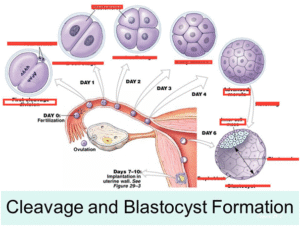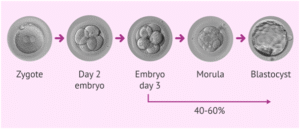
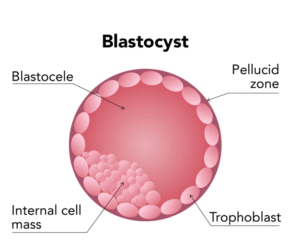
In the journey of IVF, a blastocyst is a day 5 or day 6 embryo formed after fertilization. It is the final stage of embryo development in the lab; beyond this we cannot culture in the lab. Unlike earlier stage embryos (Day 2 or Day 3), a blastocyst has more cells and a fluid filled cavity, making it more likely to implant successfully in the uterus.
THINK OF IT AS AN EMBRYO THAT HAS “GRADUATED” TO A MORE ADVANCED STAGE, READY FOR NEXT STEP – “IMPLANTATION”.
WHY IS BLASTOCYST PREFERRED ?
- Higher Implantation Rates : Embryos that survive to Day 5 are generally more stronger and more viable. Formation of Blastocyst depends on both egg and sperm quality; hence like a process of natural selection they increase the pregnancy potential by 10-15%.
- Better Embryo selection : Culturing embryos longer helps embryologists identify the best ones.
- Natural Uterine Synchrony : The uterus is often more receptive to implantation at this time. In natural conception also, implantation occurs at blastocyst stage and hence simulates a natural conception.
- Embryos available for genetic testing : Preimplantation genetic testing is carried out at blastocyst stage; so culturing to blastocyst stage gives an opportunity to carry out preimplantation genetic testing.
- Fewer Embryos, better results : As the science is advancing, we are progressing towards elective single embryo transfer. Single blastocyst transfer helps to achieve a safe pregnancy.
WHO CAN BENEFIT FROM BLASTOCYST TRANSFER ?
Blastocyst transfer is ideal for :
- Women with multiple high quality embryos
- Couples with previous failed IVF attempts
- Patients opting for elective single embryo transfer (eSET)
- Patients planned for preimplantation genetic testing
- Young women or those using donor eggs.
Personalized care is essential before planning any treatment. One Shoe doesn’t fit all.
STEP BY STEP : THE BLASTOCYST TRANSFER PROCESS :
- Ovarian Stimulation : Hormonal injections to stimulate the ovaries to produce eggs.
- Egg Retrieval : Short day care procedure carried out under anaesthesia transvaginally.
- Fertilization : Eggs and sperms are combined in the lab either through the process of IVF or ICSI.
- Embryo Culture : Embryos are cultured till day 5 or day 6.
- Embryo Transfer : It can be fresh or frozen embryo transfer; and a good quality blastocyst is gently placed into the uterus using a thin catheter.
The procedure is painless, takes just a few minutes and doesn’t require anaesthesia.
SUCCESS RATES WITH BLASTOCYST TRANSFER :
Studies show that blastocyst transfers have higher success rates than day 3 transfers, especially in younger women and in cases where good quality embryos are available.
Factors influencing success are :
- Female age
- Embryo quality
- Uterine receptivity
- Immunological factors
- Any associated medical conditions
PROS AND CONS OF BLASTOCYST TRANSFER
| ADVANTAGES | DISADVANTAGES |
| i. Higher implantation potential
ii. Better Embryo selection iii. Lower risk of multiple pregnancy |
i. Not all embryos reach day 5
ii. May not be suitable for all iii. Slightly longer culture period |
CONCLUSION :
Blastocyst transfer offers a more precise, effective and patient friendly approach to IVF. Personalized IVF matters. At our clinic, we carefully evaluate your case to recommend the most suitable strategy- be it Day 3 or Day 5 transfer.